Managing exterior maintenance for a Florida Homeowners Association (HOA), Condominium Association (COA), or townhome community in Clearwater, Dunedin, Palm Harbor, Belleair, Countryside, or Westchase requires balancing three high-stakes pressures: statutory compliance, master-policy insurance renewals, and reserve budget predictability. When sub-tropical humidity coats barrel-tile roofs in black Gloeocapsa magma cyanobacteria, turns clubhouse pool decks into slip hazards, and stains continuous concrete curbing with orange well-water rust, reactive maintenance quickly spirals into costly homeowner disputes or special assessments.
At Tampa Bay Soft Wash & Pressure Cleaning, we approach association maintenance from both sides of the board table. Co-Owner and Lead Field Operator Jessica Lakins serves as an active Florida HOA President, while Owner and Lead Technician Brian Vasquez brings former cell-tower structural inspection rigor backed by $1M general liability coverage (Progressive Commercial Policy #4608294299), OSHA 10-Hour General Industry Certification (#36-007022186), TIA/ARMA Soft Wash Certification, and dual Trident T3 Master Sealer Certifications (Codes 67509e11547140e2ae06ded7 & 6acff9d88085939585030348). This playbook gives Community Association Managers (CAMs), board members, and deed-restricted homeowners a turn-key framework for statutory compliance and multi-year exterior budgeting.
1. Navigating Florida Statute § 720.305 (HOAs) & § 718.113 (Condos): What Boards and Homeowners Must Know
In deed-restricted single-family and townhome communities across Pinellas, Pasco, and Hillsborough counties, exterior cleanliness is governed by the association's Declaration of Covenants, Conditions, and Restrictions (CC&Rs) alongside Florida Statute § 720.305. Meanwhile, condominium associations operate under the strict common-element maintenance mandates of Florida Statute § 718.113, where maintenance of the building envelope, roofs, and common walkways is the fiduciary duty of the board.
The Statutory Fining & Notice Process Under F.S. § 720.305(2)
When a homeowner's roof, driveway, sidewalk apron, or stucco facade accumulates visible algae or mildew in violation of community standards, Florida Statute § 720.305(2) establishes strict procedural guardrails:
- Fine Caps: Fines may not exceed $100 per violation, or up to $1,000 in the aggregate for a continuing violation (such as an uncleaned roof or mildewed driveway), unless the association's governing documents explicitly authorize a higher threshold. Furthermore, a fine of less than $1,000 cannot become a lien against a parcel.
- Mandatory 14-Day Written Notice & Independent Fining Committee: A board cannot unilaterally impose a fine. The parcel owner must receive at least 14 days' written notice of their opportunity for a hearing before an impartial committee of at least three members who are not officers, directors, or employees of the association (or their spouse, parent, child, brother, or sister).
- The Cure Window: Under recent Florida statutory reforms (including HB 1203 updates to Chapter 720), if the homeowner cures the exterior cleaning violation before the hearing—or within the specified cure window by hiring a certified roof cleaning or house washing professional and submitting dated before/after photo proof—the committee may not impose the fine.
Why Bulk Community Rates Beat Individual Violation Letters
Issuing dozens of individual violation notices every spring creates administrative overhead for the CAM, friction at board meetings, and a patchwork of mismatched results when 40 homeowners hire 40 different contractors. Instead, forward-thinking boards in Clearwater, Dunedin, Countryside, and Belleair either contract common-element washes directly from operating funds or arrange an HOA-Vetted Group Preferred Rate Day—allowing homeowners to book a pre-vetted, fully insured crew at volume pricing while the crew is already staged inside the gates.
"Property managers and homeowners associations need to make sure the exteriors of their complexes don't start to look run down. If the exterior of the complex isn't kept clean, rental rates and resale prices can be affected... With the extra man to pull hose and keep the water tank filled, the two men running the guns don't waste any time." — Wash On Wheels, Commercial Condominium Complex Operations
2. Multi-Building Roof Soft Washing: Protecting Master Insurance Policies Under F.S. § 627.7011
For condominium associations, townhome sub-associations, and villa communities where the association insures or maintains the roofs, biological roof staining is no longer just a cosmetic issue—it is an existential underwriting trigger. As detailed in our Florida Homeowner's Guide to Roof Insurance & Statute § 627.7011, property insurers now rely heavily on automated satellite and fixed-wing aerial AI inspections to grade roof condition before renewal.
When computer-vision algorithms detect dark colonies of Gloeocapsa magma cyanobacteria or green moss across multi-family roofs, carriers can bypass the chronological age protections of Florida Statute § 627.7011(5) and issue non-renewal notices based on "adverse surface condition." However, hiring an untrained contractor who blasts association roofs with a high-pressure wand is even more catastrophic.
Why ARMA-Compliant Soft Washing & No-Walk Protocols Are Mandatory
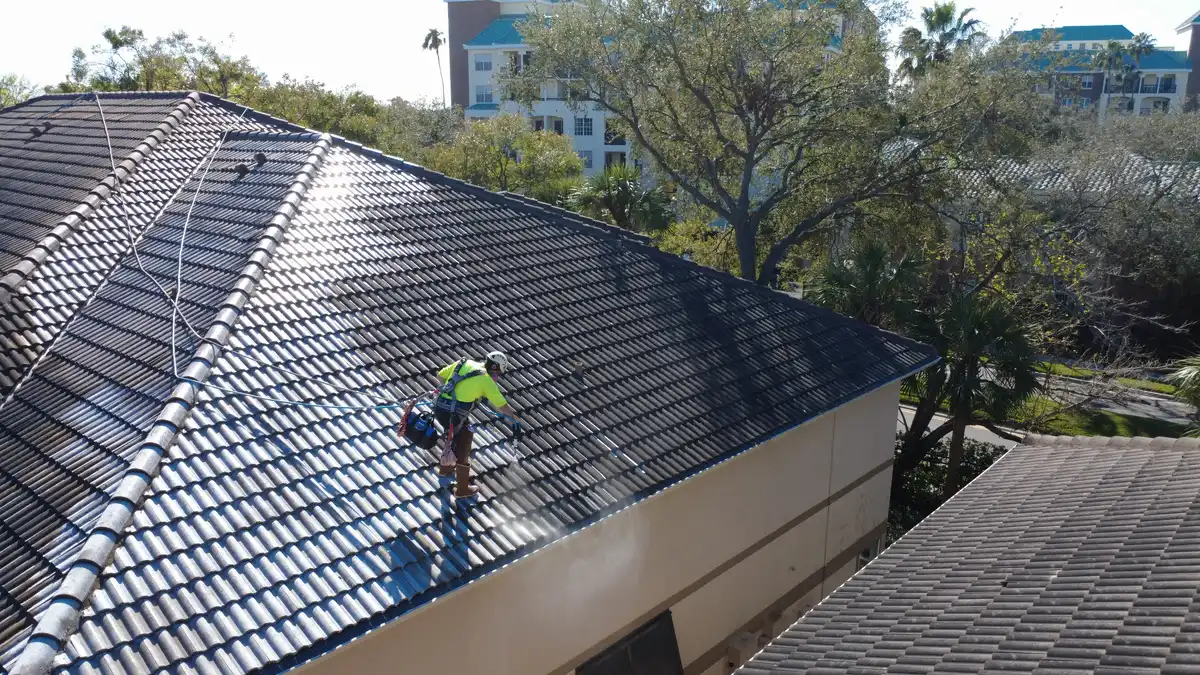
The Asphalt Roofing Manufacturers Association (ARMA) and clay/concrete tile manufacturers explicitly prohibit high-pressure washing on roofs because mechanical pressure strips UV-protective ceramic granules and fractures barrel-tile interlocks. Instead, our TIA-certified soft wash protocol uses dedicated 12-volt diaphragm pumps operating at gentle garden-hose pressure (under 60 PSI) to apply a precision-metered sodium hypochlorite (`5%–8%` SH) and surfactant solution that kills algae, moss, and lichen down to the microscopic root.
"In this example, we are doing a Spanish tile/barrel tile roof. We do our best to hit all 3 sides of this type of tile roofing... Gutters are extremely helpful. Being able to capture all of the chemical solution allows us to work much faster." — Brian Vasquez, Majestic Oaks Roof Soft Wash in Clearwater, FL (@tbsoftwash)
On single-story villas and accessible two-story townhome elevations, we prioritize a No-Walk Perimeter Application from stabilized ladder stations alongside a two-operator thermal cooling and plant-protection workflow:
"Tampa Bay Soft Wash & Pressure Cleaning would like to share our process of how we perform a roof cleaning without actually walking on the roof! ... In this video I am using a 12-volt pump to apply a pretty strong solution (6%-8% sodium hypochlorite) to completely clean this algae ridden roof. Jessica is using a water hose to rinse and I used the 8 gallon per minute pressure washer to rewet the roof real quick." — Brian Vasquez & Jessica Lakins, Seminole, FL Field Demonstration (@tbsoftwash)
- Zero Cracked Barrel Tiles: Eliminating unnecessary foot traffic on aged Spanish S-tiles and concrete barrel tiles saves associations thousands of dollars in post-wash roof tile repair bills.
- UF/IFAS-Guided Plant & Turf Protection: Following UF/IFAS Extension horticultural best practices, our ground operator saturates ornamental palms, hibiscus, and St. Augustine turf before, during, and after roof treatment, bagging gutter downspouts and applying soluble calcium sulfate (gypsum) to displace sodium ions in sensitive root zones.
3. Common-Area Liability: Sidewalks, Curbs, Pool Decks & OSHA 1910.22 Slip-and-Fall Prevention
For HOA and condo boards, common-area walkways, clubhouse entrances, ADA ramps, and pool decks represent the #1 premises liability exposure. Under OSHA 29 CFR 1910.22 (Walking-Working Surfaces) and Florida premises liability law, property owners and associations must maintain walking surfaces free of slip hazards caused by wet biological biofilm.
When shaded north-facing sidewalks or oak-canopied boulevard curbs stay damp after afternoon thunderstorms, filamentous green and black algae form a slick hydrogel layer. A single resident or guest slip-and-fall claim on an unmaintained clubhouse walkway or pool deck can exceed $30,000 to $50,000 in medical and legal defense costs—and trigger immediate scrutiny from the association's general liability carrier.
"That's what the curbs used to look like—you can see the red from the irrigation and all of that, so the blackness is now gone, looking really good, and I have a picture of this sewer drain here that was just really, really bad and now it looks just like a brand new storm drain." — T-N-T Pressure Cleaning, Florida HOA Curbing & Storm Drain Restoration
Why Surface Spinning Alone Fails Within 60 Days (The Pre/Post-Treatment Standard)
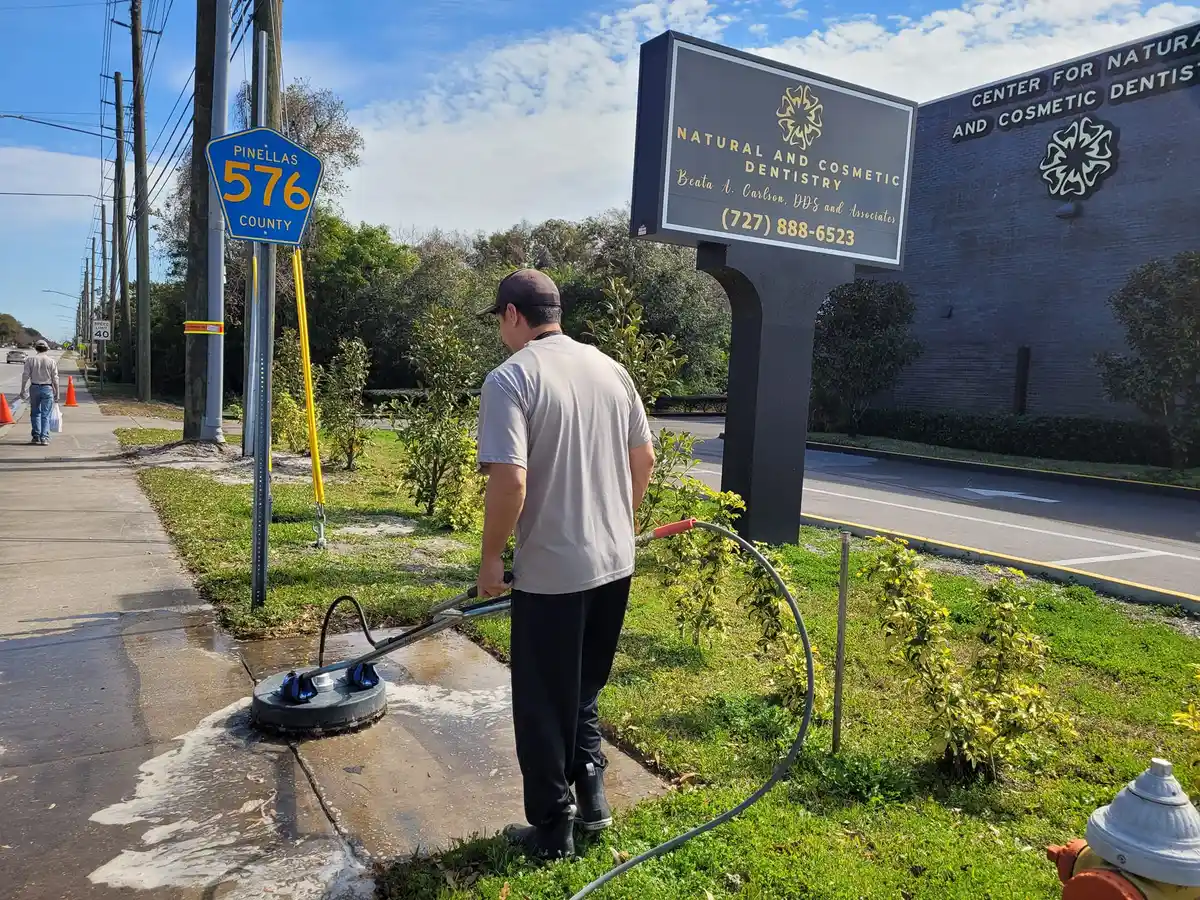
Many low-bid commercial washers simply run a cold-water rotary surface cleaner over community sidewalks and drive away. Because Florida concrete is highly porous, high-pressure water shears off the top layer of algae while leaving live microscopic spores embedded inside the concrete capillaries—resulting in unsightly "zebra striping" and rapid dark regrowth within 6 to 8 weeks. Our commercial pressure washing protocol pairs uniform rotary surface cleaning with a `1%–1.5%` sodium hypochlorite post-treatment sanitization that eliminates subsurface spores and keeps community sidewalks bright for 9 to 12 months.
- Reclaimed & Well Irrigation Rust Neutralization: Across Pinellas and Hillsborough HOAs, shallow well systems and reclaimed irrigation water leave heavy orange ferric oxide stains along white vinyl fences, stucco monuments, and street curbing. Rather than etching the concrete with raw muriatic acid, we chemically reduce iron stains using professional rust stain removal chemistry (including Oxalic Acid 99% Crystals applied via a dedicated chemical-resistant pump sprayer with chemical-resistant nitrile gloves and NIOSH organic-vapor respiratory PPE).
- Stormwater & Drain Jetting Compliance: All wash operations adhere strictly to Pinellas County NPDES Stormwater regulations. When clubhouse pool deck trench drains or common-area French drains back up with sand and oak debris, our high-pressure hydro-jetting service flushes underground lines clear before summer deluge storms flood the deck.
4. Clubhouse Pool Decks, Entry Monuments & Driveways: Exclusive Trident Protects Restoration
Brick paver entry boulevards, gatehouse aprons, and travertine clubhouse pool decks are the crown jewels of a Tampa Bay community. Yet HOA boards routinely see tens of thousands of reserve dollars wasted when contractors apply cheap big-box acrylic sealers that trap ground moisture and blush milky white—or sweep pre-blended polymeric sand that crusts over the top eighth-inch of the joint and washes out during the first tropical depression.
As an officially Certified Trident Trusted Technician (T3 University Codes 67509e11547140e2ae06ded7 & 6acff9d88085939585030348), Tampa Bay Soft Wash & Pressure Cleaning exclusively specifies commercial-grade Trident Protects sealers and washed angular silica sand graded strictly to ASTM C-144 masonry standards:
- Surface Decontamination & Stripping (`Jetty`, `Break Wall` & `Sea Wall`): We chemically lift white calcium efflorescence, rust, and organic tannins using Trident Jetty, and strip failed legacy solvent/acrylic coatings from community pool decks using Trident Break Wall and Sea Wall.
- Full-Depth ASTM C-144 Joint Stabilization: Angular ASTM C-144 silica grains pack tightly to the full depth of the paver joint, preventing "bird pooling" and vehicle tire rutting at high-traffic gatehouse entrances.
- Breathable 2-Part Urethane & Natural Stone Protection (`Hurricane CAT 4`, `Hurricane CAT 5`, `Tsunami`, `Cyclone` & `Typhoon`): For high-traffic community entrances and pool decks requiring maximum joint lock and anti-fungal protection, we apply Trident Hurricane CAT 5 (ultra-durable wet look with Armor Bond™ and T3 True Tone™) or Hurricane CAT 4. For associations preferring a satin, semi-gloss, matte, or invisible penetrating salt-water barrier on coastal travertine, we match Tsunami, Typhoon, Cyclone, Break Wall, or Sea Wall with non-slip shark-grip traction additives for wet pool decks.
5. The CAM & HOA Board Annual Budgeting Matrix
To prevent deferred-maintenance spikes and keep annual operating vs. statutory reserve budgets predictable, we recommend structuring your association's exterior cleaning RFP around this Florida service cadence:
| Community Asset / Surface | Recommended Florida Cadence | Primary Method & Chemistry | Risk Mitigated (Legal / Insurance / Reserve) |
|---|---|---|---|
| Clubhouse Pool Deck, Restroom Walkways & ADA Ramps | Quarterly or Semi-Annual (Spring & Fall) | Rotary surface cleaning + `1.5%` SH sanitization + non-slip Trident sealer maintenance | Eliminates OSHA `1910.22` slip-and-fall algae hazards and Dept. of Health pool-deck citations. |
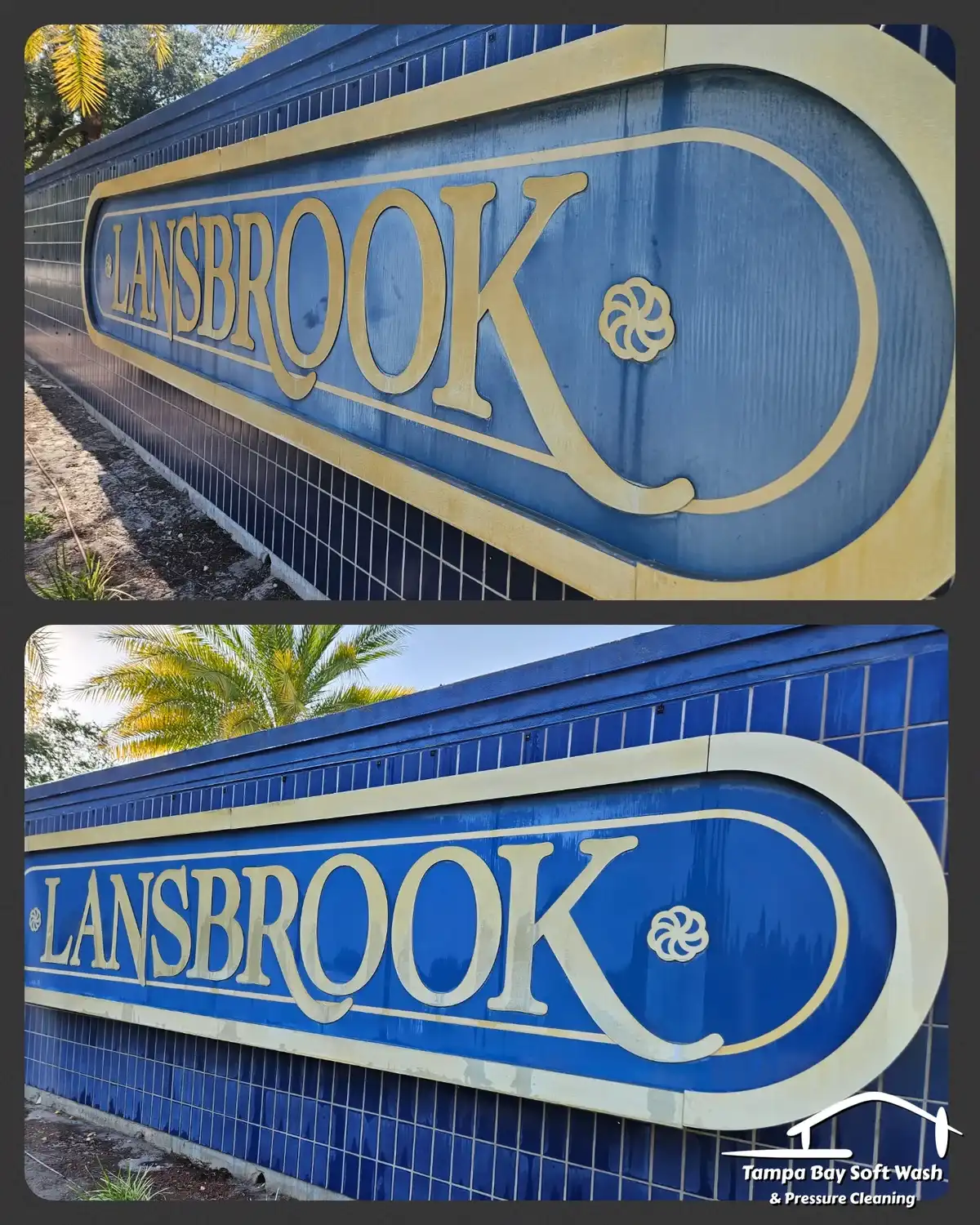
| Boulevard Sidewalks, Continuous Curbing & Entry Monuments | Annual (Pre-rainy season or pre-annual meeting) | High-GPM rotary cleaning + SH post-treat + Oxalic / Jetty irrigation rust removal | Preserves community appraisal values and sets the benchmark for F.S. `§ 720.305` homeowner compliance. |
| Multi-Family / Condo Building Envelopes, Soffits & Gutters | Annual to 18 Months | Low-pressure (`< 60 PSI`) 12V soft wash + gutter debris flush & tiger-stripe brightening | Satisfies F.S. `§ 718.113` building-envelope preservation and prevents stucco moisture intrusion. |
| Tile, Shingle & Metal Roofs (Condo / Townhome / Villa) | Every 24 to 36 Months (Before dark streaks mature into moss) | ARMA-compliant 12V soft wash (`5%–8%` SH + surfactant) with No-Walk perimeter priority | Prevents aerial AI underwriting flags and master-policy non-renewal under F.S. `§ 627.7011`. |
| Paver Gatehouses, Pool Lanais & Dumpster Pads | Pavers: Every 2–3 Years Dumpster Pads: Monthly / Quarterly |
ASTM C-144 sand + Trident Hurricane CAT 4/5; `Stampede Plus` / `FOG Away` degreasing on dumpster pads | Stops paver settling ("bird pooling"), weed intrusion, and rodent/odor complaints at shared corrals. |
6. The 5-Point Vendor Vetting Checklist Before Signing an HOA Contract
Before awarding a common-area maintenance contract or adding a preferred vendor to your resident portal, require every bidding contractor to submit proof of these five non-negotiable credentials (all of which you can verify instantly on our Public Compliance & Credentials Vault):
- Active $1,000,000 Commercial General Liability COI: Verify the policy covers commercial exterior cleaning and multi-family roof operations—not a basic handyman policy that excludes roof work. We carry a $1,000,000 commercial liability insurance policy with Progressive Commercial (Policy
#4608294299) and issue custom Certificates of Insurance naming your HOA/COA and management company as Additional Insured. - Documented OSHA Safety Training: Ensure lead technicians hold verifiable OSHA credentials (Brian Vasquez holds OSHA 10-Hour General Industry Card
#36-007022186) and enforce cone/barricade perimeters around active hoses. - Manufacturer-Backed Roof & Sealer Certifications: Demand TIA / ARMA Soft Wash Certification for roofs and Trident T3 Certified Master Sealer credentials (Codes
67509e11547140e2ae06ded7&6acff9d88085939585030348, verifiable at866-951-4293) for hardscapes. - Phased Resident Notification Map: For multi-building condo or townhome projects, we provide your CAM with a color-coded daily building map and 48-hour resident notice templates (instructing residents to close windows, clear patios, and move vehicles from immediate spray zones).
- Proactive "Eyes & Ears" Photo Inspection Report: Because our owners are on site for every community project, we photograph pre-existing cracked tiles, clogged downspouts, irrigation leaks, or trip hazards and deliver a clean digital report for your board packet.
Frequently Asked Questions for HOA Boards, CAMs & Homeowners
Can a Florida HOA fine a homeowner immediately for a dirty roof or driveway under Statute § 720.305?
No. Under Florida Statute § 720.305(2), an HOA must provide at least 14 days' written notice and an opportunity for a hearing before an independent committee of at least three members who are unrelated to board directors. If the homeowner cures the violation by having the roof or driveway professionally cleaned within the notice/cure window, the fine cannot be imposed. We offer priority scheduling and timestamped completion certificates + before/after photos that homeowners can email directly to their CAM to close out open violations.
Do you provide Additional Insured Certificates of Insurance (COI) and W-9s for property management vendor portals?
Yes. We routinely onboard with Tampa Bay Community Association Management firms and vendor compliance portals. You can download our W-9, Florida LLC registration, OSHA-10 card, Trident T3 certificates, and $1,000,000 commercial liability insurance policy (Progressive Policy #4608294299) directly from our Documents page, and we issue custom Additional Insured COIs within 24 hours.
How do you handle water access and resident parking during a multi-building condo or townhome wash?
Before mobilizing, Brian and Jessica walk the property with the CAM or board liaison to map common-element spigots/hydrants, backflow requirements, and phased building zones. We supply the board with a 48-hour resident notice map so only one small section of parking or walkway is coned off at any time, allowing us to clean multi-building complexes rapidly with minimal disruption.
Can our HOA arrange a "Community Group Rate Day" for individual homeowners who received roof or driveway notices?
Absolutely. Many Clearwater, Dunedin, Palm Harbor, and Westchase boards coordinate a voluntary Community Wash Week with us—either right after we clean the common-area sidewalks/clubhouse or ahead of annual inspections. Because our rig is already staged inside the neighborhood, participating homeowners receive a discounted group rate on roof soft washing, house washing, and Trident paver sealing.
🎓 Go Deeper: Commercial & HOA Exterior Cleaning SOPs
Explore our complete surface chemistry ratios, plant protection checklists, and multi-building safety protocols in the free Tampa Bay Soft Wash Academy.
Start Learning → academy.tbsoftwash.com